
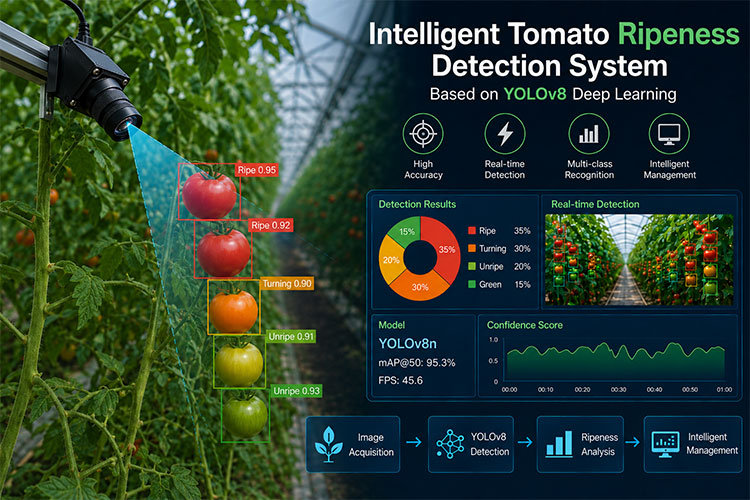

Abstract: With the intelligent development of modern agriculture, traditional manual tomato ripeness detection methods suffer from low efficiency, strong subjectivity, and high labor costs. To improve the accuracy and efficiency of tomato ripeness detection, this paper designs and implements an intelligent tomato ripeness detection system based on deep learning.
Content Summary
The intelligent and efficient assessment of tomato ripeness represents a critical challenge in modern precision agriculture. Manual inspection methods are labor-intensive, time-consuming, and subject to significant inter-observer variability, making them inadequate for large-scale agricultural production. This paper presents a comprehensive intelligent tomato ripeness detection system that integrates state-of-the-art deep learning with a modern, full-stack web architecture to address these limitations. The proposed system employs the YOLOv8n object detection model — the nano variant of the eighth-generation You Only Look Once architecture — trained on a curated dataset of 1,420 annotated tomato images, achieving a mean Average Precision at IoU 0.5 (mAP@0.5) of 76.84%, a precision of 81.05%, a recall of 70.64%, and an F1 score of 75.49% across four fine-grained ripeness categories: unripe, turning, semi-ripe, and ripe.
The backend infrastructure is built upon the Django REST Framework, providing a robust RESTful API layer secured by JSON Web Token (JWT) authentication. The frontend user interface is developed using Vue 3 with the Element Plus component library, delivering a responsive single-page application experience. The system encompasses five core functional modules: a detection workbench for real-time image analysis, a dashboard for statistical visualization using ECharts, a history management system for detection record tracking, a model performance monitoring interface, and a user profile center. Persistent data storage is implemented via a relational database for detection records and user information, alongside a file system for uploaded and annotated images.
The model was trained over 150 epochs using the Stochastic Gradient Descent (SGD) optimizer with an adaptive learning rate schedule on a dataset split into 993 training, 284 validation, and 143 test images. Experimental results demonstrate that the system achieves reliable multi-class tomato ripeness detection with high confidence levels averaging 0.9471, effectively supporting real-world agricultural decision-making scenarios. This paper details the complete system design philosophy, dataset construction methodology, YOLOv8 architectural analysis, training strategy, implementation specifics, and comprehensive evaluation. The system provides a practical, scalable, and deployable solution for smart agricultural applications, graduation project demonstrations, and precision farming research.
Document Overview
Document Information
Version: Draft
Total pages: 55
Word count: 15,256 words
File format: Editable Word document
Figures and tables: 19 figures and 2 tables
Table of Contents
Abstract 1
1. Introduction 5
2. Related Work 7
2.1 Object Detection Algorithms 7
2.2 Deep Learning in Precision Agriculture 9
2.3 Web-Based AI Detection Systems 11
3. System Architecture 13
3.1 Overall Architecture Design 13
3.2 Technology Stack Selection 14
3.3 Core System Workflow 15
4. Dataset Construction and Preprocessing 17
4.1 Data Source and Collection 17
4.2 Dataset Statistics and Distribution 17
4.3 Data Preprocessing and Augmentation 19
4.4 Annotation Quality and Validation 20
5. YOLOv8 Model Design and Training 20
5.1 YOLOv8 Architecture Overview 20
5.2 Backbone Network 22
5.3 Neck: Feature Pyramid Network with PANet 23
5.4 Detection Head and Anchor-Free Prediction 23
5.5 Loss Functions 24
5.6 Training Configuration and Transfer Learning 25
6. System Implementation 27
6.1 Frontend Development with Vue 3 and Element Plus 27
6.2 Detection Workbench Interface 29
6.3 Dashboard and Statistical Analysis 31
6.4 History Records Management 31
6.5 Backend API Design and Implementation 33
6.6 Database Schema and Storage Design 34
6.7 API Response Format and Error Handling 35
7. Experimental Results and Analysis 37
7.1 Experimental Setup 37
7.2 Training Process Analysis 37
7.3 Model Performance Summary 39
7.4 Confusion Matrix Analysis 40
7.5 Precision-Recall Curve Analysis 41
7.6 F1-Confidence Curve Analysis 43
7.7 System Integration and Deployment Testing 45
8. Discussion 46
9. Conclusion and Future Work 49
References 52
Related Project
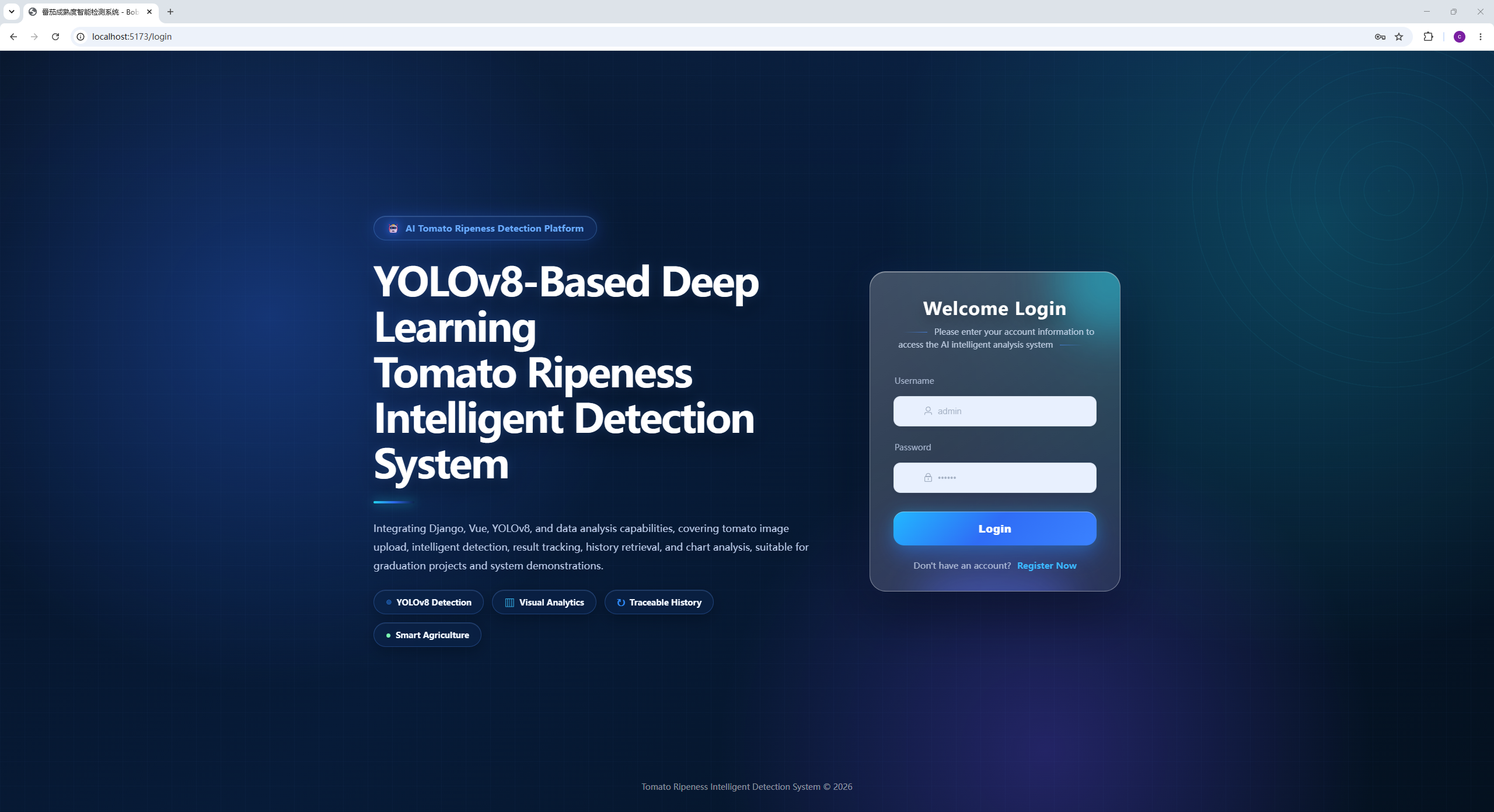
Figure 1 Intelligent Tomato Ripeness Detection System Based on YOLOv8 Deep Learning
Project Information
Author Information
Author: Bob (Zhang Jialiang)
Project ID: AI-EN-2-Doc
Originality Statement: This project is an original work.
Contact Information
Email: wesharecode2023@gmail.com
GitHub:https://github.com/7zcode
YouTube:https://www.youtube.com/@7zcode
Open Source License
This project is licensed under the AGPL-3.0 License. You may use, modify, and distribute the code, but derivative works must also remain open source under the same license. If the project is used to provide network services, the complete source code must be made available to users.
This project is for learning and research purposes only. Users are responsible for complying with local laws and regulations. If this project is helpful, citation and attribution are appreciated.

评论(1)